Home / Inspection Services / Advanced NDT Services / Internal Rotary Inspection System (IRIS)
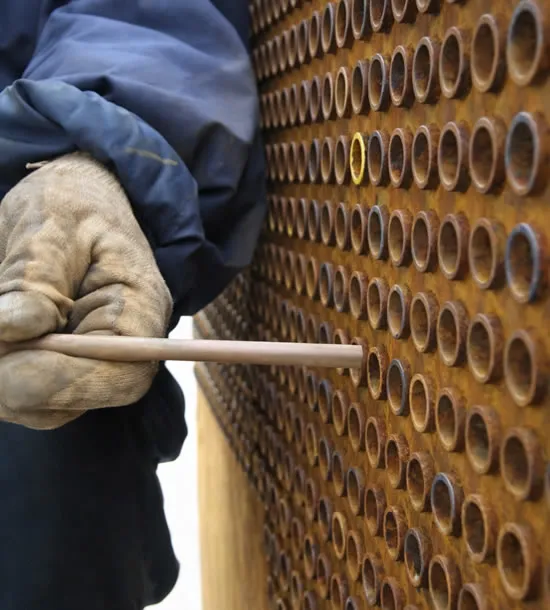
IRIS is a Non - Destructive Ultrasonic Testing method for pipes and tubes.
Many plant operators in the oil and gas and power generation industries face the challenge of increasing asset efficiency and life expectancy while maintaining safety and reliability. As a result, accurate inspection of critical components such as pipes and tubes is critical to ensuring the plant's integrity.
Internal Rotary Inspection System (IRIS) is most commonly used for tube inspection in boilers, heat exchangers, air coolers and feedwater heaters and can detect corrosion, pitting and wall loss. It is particularly versatile because it can be used on a wide range of tube diameters and wall thicknesses and is suitable for both ferrous and Non - Ferrous materials.
An IRIS probe is inserted into a water - filled tube. The probe is outfitted with a transducer that generates an ultrasonic pulse parallel to the tube's axis. The ultrasonic pulse is directed into the tube wall by a rotating mirror. The mirror is propelled by a small turbine that rotates due to the pressure of water pumped into the tube. The ultrasound pulses are reflected by the tube's inner diameter (ID) and outer diameter (OD) walls and the time of flight difference between the two diameters is used to calculate the thickness of the wall. As the IRIS probe is dragged, the spinning motion of the mirror creates a helical scan path that ensures complete coverage of the tube.
An IRIS probe is inserted into a water - filled tube. The probe is outfitted with a transducer that generates an ultrasonic pulse parallel to the tube's axis. The ultrasonic pulse is directed into the tube wall by a rotating mirror. The mirror is propelled by a small turbine that rotates due to the pressure of water pumped into the tube. The ultrasound pulses are reflected by the tube’s inner diameter (ID) and outer diameter (OD) walls and the time of flight difference between the two diameters is used to calculate the thickness of the wall. As the IRIS probe is dragged, the spinning motion of the mirror creates a helical scan path that ensures complete coverage of the tube.

Copyright © 2026 www.qinspec.ae. All Rights Reserved.

